Nápady 115+ Atom Nuclear Fission Vynikající
Nápady 115+ Atom Nuclear Fission Vynikající. The sum of the masses of these fragments is less than the original mass. This 'missing' mass (about 0.1 percent of the original mass) has been converted into energy according to einstein's equation. Nuclear fission is a process where the nucleus of an atom is split into two or more smaller nuclei, known as fission products.

Tady Nuclear Chain Reactions
The energy released by fission in these reactors heats water into steam. Nuclear fission is a process where the nucleus of an atom is split into two or more smaller nuclei, known as fission products. When a nucleus fissions, it splits into several smaller fragments. In commercial power reactors, neutrons are used to trigger nuclear fission. This 'missing' mass (about 0.1 percent of the original mass) has been converted into energy according to einstein's equation.The fission of heavy elements is an exothermic reaction, and huge amounts of energy are released in the process.
The fission of heavy elements is an exothermic reaction, and huge amounts of energy are released in the process. Uranium and plutonium are most commonly used for fission reactions in nuclear power reactors because they are easy to initiate and control. A new type of nuclear reaction and physical evidence for the division of heavy nuclei under neutron bombardment—used the term … The fission of heavy elements is an exothermic reaction, and huge amounts of energy are released in the process. In commercial power reactors, neutrons are used to trigger nuclear fission. 04.06.2014 · both reports—disintegration of uranium by neutrons: When a nucleus fissions, it splits into several smaller fragments. There are also ways to modulate the chain reaction by soaking up the neutrons.

Uranium and plutonium are most commonly used for fission reactions in nuclear power reactors because they are easy to initiate and control. When a nucleus fissions, it splits into several smaller fragments. The fission process also releases extra neutrons, which can then split additional atoms, resulting in a chain reaction that releases a lot of energy.. This 'missing' mass (about 0.1 percent of the original mass) has been converted into energy according to einstein's equation.

01.04.2021 · when each atom splits, a tremendous amount of energy is released. A new type of nuclear reaction and physical evidence for the division of heavy nuclei under neutron bombardment—used the term … Free neutrons can be captured by a nucleus. Nuclear fission in nuclear fission, an unstable atom splits into two or more smaller pieces that are more stable, and releases energy in the process. In most nuclear reactors, the initial high energy of the free neutrons released during fission is reduced (moderated) until there is a high probability that they will be captured by a nucleus. This process is known as fission (see diagram below).. Uranium and plutonium are most commonly used for fission reactions in nuclear power reactors because they are easy to initiate and control.

A new type of nuclear reaction and physical evidence for the division of heavy nuclei under neutron bombardment—used the term … Nuclear fission in nuclear fission, an unstable atom splits into two or more smaller pieces that are more stable, and releases energy in the process.

Nuclear fission in nuclear fission, an unstable atom splits into two or more smaller pieces that are more stable, and releases energy in the process. 01.04.2021 · when each atom splits, a tremendous amount of energy is released. A new type of nuclear reaction and physical evidence for the division of heavy nuclei under neutron bombardment—used the term … Nuclear fission in nuclear fission, an unstable atom splits into two or more smaller pieces that are more stable, and releases energy in the process. This 'missing' mass (about 0.1 percent of the original mass) has been converted into energy according to einstein's equation. Nuclear fission occurs with heavier elements, where the electromagnetic force pushing the nucleus apart dominates. When a nucleus fissions, it splits into several smaller fragments. This process is known as fission (see diagram below).

Two or three neutrons are also emitted. This 'missing' mass (about 0.1 percent of the original mass) has been converted into energy according to einstein's equation. Two or three neutrons are also emitted. These fragments, or fission products, are about equal to half the original mass. In commercial power reactors, neutrons are used to trigger nuclear fission. Nuclear fission in nuclear fission, an unstable atom splits into two or more smaller pieces that are more stable, and releases energy in the process. Uranium and plutonium are most commonly used for fission reactions in nuclear power reactors because they are easy to initiate and control. This process is known as fission (see diagram below). Free neutrons can be captured by a nucleus.. 04.06.2014 · both reports—disintegration of uranium by neutrons:

These fragments, or fission products, are about equal to half the original mass.. Uranium and plutonium are most commonly used for fission reactions in nuclear power reactors because they are easy to initiate and control. The sum of the masses of these fragments is less than the original mass. Nuclear fission occurs with heavier elements, where the electromagnetic force pushing the nucleus apart dominates. These fragments, or fission products, are about equal to half the original mass. In most nuclear reactors, the initial high energy of the free neutrons released during fission is reduced (moderated) until there is a high probability that they will be captured by a nucleus. Free neutrons can be captured by a nucleus. This 'missing' mass (about 0.1 percent of the original mass) has been converted into energy according to einstein's equation. The fission of heavy elements is an exothermic reaction, and huge amounts of energy are released in the process. The fission process also releases extra neutrons, which can then split additional atoms, resulting in a chain reaction that releases a lot of energy. Nuclear fission in nuclear fission, an unstable atom splits into two or more smaller pieces that are more stable, and releases energy in the process.

Uranium and plutonium are most commonly used for fission reactions in nuclear power reactors because they are easy to initiate and control... Free neutrons can be captured by a nucleus. Nuclear fission is a process where the nucleus of an atom is split into two or more smaller nuclei, known as fission products. The fission of heavy elements is an exothermic reaction, and huge amounts of energy are released in the process. The energy released by fission in these reactors heats water into steam. Nuclear fission in nuclear fission, an unstable atom splits into two or more smaller pieces that are more stable, and releases energy in the process. In most nuclear reactors, the initial high energy of the free neutrons released during fission is reduced (moderated) until there is a high probability that they will be captured by a nucleus. These fragments, or fission products, are about equal to half the original mass. 01.04.2021 · when each atom splits, a tremendous amount of energy is released. Uranium and plutonium are most commonly used for fission reactions in nuclear power reactors because they are easy to initiate and control.. This process is known as fission (see diagram below).

Uranium and plutonium are most commonly used for fission reactions in nuclear power reactors because they are easy to initiate and control.. If the neutron is captured, this produces a nuclide, whose nucleus is in an excited state; These fragments, or fission products, are about equal to half the original mass. This process is known as fission (see diagram below). Nuclear fission in nuclear fission, an unstable atom splits into two or more smaller pieces that are more stable, and releases energy in the process. Two or three neutrons are also emitted. Uranium and plutonium are most commonly used for fission reactions in nuclear power reactors because they are easy to initiate and control. This 'missing' mass (about 0.1 percent of the original mass) has been converted into energy according to einstein's equation. The fission process also releases extra neutrons, which can then split additional atoms, resulting in a chain reaction that releases a lot of energy. The sum of the masses of these fragments is less than the original mass.

The sum of the masses of these fragments is less than the original mass... The sum of the masses of these fragments is less than the original mass. Free neutrons can be captured by a nucleus. There are also ways to modulate the chain reaction by soaking up the neutrons. A new type of nuclear reaction and physical evidence for the division of heavy nuclei under neutron bombardment—used the term … The energy released by fission in these reactors heats water into steam. This process is known as fission (see diagram below). Nuclear fission in nuclear fission, an unstable atom splits into two or more smaller pieces that are more stable, and releases energy in the process. Nuclear fission is a process where the nucleus of an atom is split into two or more smaller nuclei, known as fission products. This 'missing' mass (about 0.1 percent of the original mass) has been converted into energy according to einstein's equation. The fission process also releases extra neutrons, which can then split additional atoms, resulting in a chain reaction that releases a lot of energy... Two or three neutrons are also emitted.

Nuclear fission in nuclear fission, an unstable atom splits into two or more smaller pieces that are more stable, and releases energy in the process. Nuclear fission is a process where the nucleus of an atom is split into two or more smaller nuclei, known as fission products. Nuclear fission in nuclear fission, an unstable atom splits into two or more smaller pieces that are more stable, and releases energy in the process. There are also ways to modulate the chain reaction by soaking up the neutrons. The fission of heavy elements is an exothermic reaction, and huge amounts of energy are released in the process. When a nucleus fissions, it splits into several smaller fragments.. 01.04.2021 · when each atom splits, a tremendous amount of energy is released.

This process is known as fission (see diagram below). 01.04.2021 · when each atom splits, a tremendous amount of energy is released. If the neutron is captured, this produces a nuclide, whose nucleus is in an excited state; Uranium and plutonium are most commonly used for fission reactions in nuclear power reactors because they are easy to initiate and control. The sum of the masses of these fragments is less than the original mass. The fission of heavy elements is an exothermic reaction, and huge amounts of energy are released in the process. Nuclear fission is a process where the nucleus of an atom is split into two or more smaller nuclei, known as fission products. These fragments, or fission products, are about equal to half the original mass.. If the neutron is captured, this produces a nuclide, whose nucleus is in an excited state;

01.04.2021 · when each atom splits, a tremendous amount of energy is released.. 01.04.2021 · when each atom splits, a tremendous amount of energy is released. Uranium and plutonium are most commonly used for fission reactions in nuclear power reactors because they are easy to initiate and control. There are also ways to modulate the chain reaction by soaking up the neutrons. Nuclear fission in nuclear fission, an unstable atom splits into two or more smaller pieces that are more stable, and releases energy in the process.

The sum of the masses of these fragments is less than the original mass. The fission of heavy elements is an exothermic reaction, and huge amounts of energy are released in the process.

Nuclear fission in nuclear fission, an unstable atom splits into two or more smaller pieces that are more stable, and releases energy in the process.. Free neutrons can be captured by a nucleus. 01.04.2021 · when each atom splits, a tremendous amount of energy is released. This 'missing' mass (about 0.1 percent of the original mass) has been converted into energy according to einstein's equation. In commercial power reactors, neutrons are used to trigger nuclear fission. This process is known as fission (see diagram below). The energy released by fission in these reactors heats water into steam. Nuclear fission occurs with heavier elements, where the electromagnetic force pushing the nucleus apart dominates.. This 'missing' mass (about 0.1 percent of the original mass) has been converted into energy according to einstein's equation.

Nuclear fission occurs with heavier elements, where the electromagnetic force pushing the nucleus apart dominates. This process is known as fission (see diagram below). Nuclear fission is a process where the nucleus of an atom is split into two or more smaller nuclei, known as fission products. In commercial power reactors, neutrons are used to trigger nuclear fission. The sum of the masses of these fragments is less than the original mass. If the neutron is captured, this produces a nuclide, whose nucleus is in an excited state; Free neutrons can be captured by a nucleus. When a nucleus fissions, it splits into several smaller fragments. The energy released by fission in these reactors heats water into steam. The fission process also releases extra neutrons, which can then split additional atoms, resulting in a chain reaction that releases a lot of energy. There are also ways to modulate the chain reaction by soaking up the neutrons... The sum of the masses of these fragments is less than the original mass.

Nuclear fission is a process where the nucleus of an atom is split into two or more smaller nuclei, known as fission products. The sum of the masses of these fragments is less than the original mass. In most nuclear reactors, the initial high energy of the free neutrons released during fission is reduced (moderated) until there is a high probability that they will be captured by a nucleus. Free neutrons can be captured by a nucleus. When a nucleus fissions, it splits into several smaller fragments... When a nucleus fissions, it splits into several smaller fragments.

01.04.2021 · when each atom splits, a tremendous amount of energy is released. The sum of the masses of these fragments is less than the original mass.

Nuclear fission is a process where the nucleus of an atom is split into two or more smaller nuclei, known as fission products... There are also ways to modulate the chain reaction by soaking up the neutrons. The sum of the masses of these fragments is less than the original mass. 04.06.2014 · both reports—disintegration of uranium by neutrons: The fission process also releases extra neutrons, which can then split additional atoms, resulting in a chain reaction that releases a lot of energy. These fragments, or fission products, are about equal to half the original mass. There are also ways to modulate the chain reaction by soaking up the neutrons.

The fission of heavy elements is an exothermic reaction, and huge amounts of energy are released in the process.. These fragments, or fission products, are about equal to half the original mass. The energy released by fission in these reactors heats water into steam. 01.04.2021 · when each atom splits, a tremendous amount of energy is released. The fission of heavy elements is an exothermic reaction, and huge amounts of energy are released in the process. Uranium and plutonium are most commonly used for fission reactions in nuclear power reactors because they are easy to initiate and control. Nuclear fission is a process where the nucleus of an atom is split into two or more smaller nuclei, known as fission products. This process is known as fission (see diagram below)... Free neutrons can be captured by a nucleus.

A new type of nuclear reaction and physical evidence for the division of heavy nuclei under neutron bombardment—used the term … These fragments, or fission products, are about equal to half the original mass. This 'missing' mass (about 0.1 percent of the original mass) has been converted into energy according to einstein's equation. A new type of nuclear reaction and physical evidence for the division of heavy nuclei under neutron bombardment—used the term … Free neutrons can be captured by a nucleus. This process is known as fission (see diagram below). In most nuclear reactors, the initial high energy of the free neutrons released during fission is reduced (moderated) until there is a high probability that they will be captured by a nucleus. 04.06.2014 · both reports—disintegration of uranium by neutrons: There are also ways to modulate the chain reaction by soaking up the neutrons.

01.04.2021 · when each atom splits, a tremendous amount of energy is released.. If the neutron is captured, this produces a nuclide, whose nucleus is in an excited state; In commercial power reactors, neutrons are used to trigger nuclear fission. Free neutrons can be captured by a nucleus. This process is known as fission (see diagram below). When a nucleus fissions, it splits into several smaller fragments. In most nuclear reactors, the initial high energy of the free neutrons released during fission is reduced (moderated) until there is a high probability that they will be captured by a nucleus.. These fragments, or fission products, are about equal to half the original mass.

These fragments, or fission products, are about equal to half the original mass. Two or three neutrons are also emitted. Free neutrons can be captured by a nucleus. A new type of nuclear reaction and physical evidence for the division of heavy nuclei under neutron bombardment—used the term … These fragments, or fission products, are about equal to half the original mass. The fission of heavy elements is an exothermic reaction, and huge amounts of energy are released in the process. If the neutron is captured, this produces a nuclide, whose nucleus is in an excited state;.. In most nuclear reactors, the initial high energy of the free neutrons released during fission is reduced (moderated) until there is a high probability that they will be captured by a nucleus.
A new type of nuclear reaction and physical evidence for the division of heavy nuclei under neutron bombardment—used the term … . This process is known as fission (see diagram below).

There are also ways to modulate the chain reaction by soaking up the neutrons.. This process is known as fission (see diagram below). A new type of nuclear reaction and physical evidence for the division of heavy nuclei under neutron bombardment—used the term … Free neutrons can be captured by a nucleus. Nuclear fission is a process where the nucleus of an atom is split into two or more smaller nuclei, known as fission products. The fission process also releases extra neutrons, which can then split additional atoms, resulting in a chain reaction that releases a lot of energy.. When a nucleus fissions, it splits into several smaller fragments.

This process is known as fission (see diagram below).. Nuclear fission is a process where the nucleus of an atom is split into two or more smaller nuclei, known as fission products. In commercial power reactors, neutrons are used to trigger nuclear fission. This 'missing' mass (about 0.1 percent of the original mass) has been converted into energy according to einstein's equation. 04.06.2014 · both reports—disintegration of uranium by neutrons:. When a nucleus fissions, it splits into several smaller fragments.

These fragments, or fission products, are about equal to half the original mass... A new type of nuclear reaction and physical evidence for the division of heavy nuclei under neutron bombardment—used the term … 04.06.2014 · both reports—disintegration of uranium by neutrons: The fission of heavy elements is an exothermic reaction, and huge amounts of energy are released in the process. In commercial power reactors, neutrons are used to trigger nuclear fission. There are also ways to modulate the chain reaction by soaking up the neutrons.. A new type of nuclear reaction and physical evidence for the division of heavy nuclei under neutron bombardment—used the term …
This process is known as fission (see diagram below).. A new type of nuclear reaction and physical evidence for the division of heavy nuclei under neutron bombardment—used the term … This process is known as fission (see diagram below).. Free neutrons can be captured by a nucleus.

Nuclear fission is a process where the nucleus of an atom is split into two or more smaller nuclei, known as fission products. This process is known as fission (see diagram below). 01.04.2021 · when each atom splits, a tremendous amount of energy is released. The energy released by fission in these reactors heats water into steam. If the neutron is captured, this produces a nuclide, whose nucleus is in an excited state; Two or three neutrons are also emitted. These fragments, or fission products, are about equal to half the original mass. When a nucleus fissions, it splits into several smaller fragments. In most nuclear reactors, the initial high energy of the free neutrons released during fission is reduced (moderated) until there is a high probability that they will be captured by a nucleus... When a nucleus fissions, it splits into several smaller fragments.

A new type of nuclear reaction and physical evidence for the division of heavy nuclei under neutron bombardment—used the term … .. 04.06.2014 · both reports—disintegration of uranium by neutrons:

Uranium and plutonium are most commonly used for fission reactions in nuclear power reactors because they are easy to initiate and control. The fission process also releases extra neutrons, which can then split additional atoms, resulting in a chain reaction that releases a lot of energy. The sum of the masses of these fragments is less than the original mass. Free neutrons can be captured by a nucleus. The fission of heavy elements is an exothermic reaction, and huge amounts of energy are released in the process. There are also ways to modulate the chain reaction by soaking up the neutrons. These fragments, or fission products, are about equal to half the original mass. Nuclear fission in nuclear fission, an unstable atom splits into two or more smaller pieces that are more stable, and releases energy in the process.

04.06.2014 · both reports—disintegration of uranium by neutrons:.. . These fragments, or fission products, are about equal to half the original mass.

Nuclear fission occurs with heavier elements, where the electromagnetic force pushing the nucleus apart dominates.. .. A new type of nuclear reaction and physical evidence for the division of heavy nuclei under neutron bombardment—used the term …

The fission of heavy elements is an exothermic reaction, and huge amounts of energy are released in the process. Nuclear fission occurs with heavier elements, where the electromagnetic force pushing the nucleus apart dominates. 01.04.2021 · when each atom splits, a tremendous amount of energy is released. Uranium and plutonium are most commonly used for fission reactions in nuclear power reactors because they are easy to initiate and control. In commercial power reactors, neutrons are used to trigger nuclear fission. Nuclear fission in nuclear fission, an unstable atom splits into two or more smaller pieces that are more stable, and releases energy in the process. The fission process also releases extra neutrons, which can then split additional atoms, resulting in a chain reaction that releases a lot of energy. A new type of nuclear reaction and physical evidence for the division of heavy nuclei under neutron bombardment—used the term …. In commercial power reactors, neutrons are used to trigger nuclear fission.

This process is known as fission (see diagram below)... The fission of heavy elements is an exothermic reaction, and huge amounts of energy are released in the process. When a nucleus fissions, it splits into several smaller fragments. This 'missing' mass (about 0.1 percent of the original mass) has been converted into energy according to einstein's equation.. This process is known as fission (see diagram below).

01.04.2021 · when each atom splits, a tremendous amount of energy is released. In commercial power reactors, neutrons are used to trigger nuclear fission. There are also ways to modulate the chain reaction by soaking up the neutrons.

These fragments, or fission products, are about equal to half the original mass... Two or three neutrons are also emitted. The sum of the masses of these fragments is less than the original mass. These fragments, or fission products, are about equal to half the original mass. Nuclear fission occurs with heavier elements, where the electromagnetic force pushing the nucleus apart dominates. When a nucleus fissions, it splits into several smaller fragments.

If the neutron is captured, this produces a nuclide, whose nucleus is in an excited state; 01.04.2021 · when each atom splits, a tremendous amount of energy is released. If the neutron is captured, this produces a nuclide, whose nucleus is in an excited state; The fission of heavy elements is an exothermic reaction, and huge amounts of energy are released in the process. These fragments, or fission products, are about equal to half the original mass. This process is known as fission (see diagram below). Nuclear fission in nuclear fission, an unstable atom splits into two or more smaller pieces that are more stable, and releases energy in the process.. Free neutrons can be captured by a nucleus.

If the neutron is captured, this produces a nuclide, whose nucleus is in an excited state; Free neutrons can be captured by a nucleus. Uranium and plutonium are most commonly used for fission reactions in nuclear power reactors because they are easy to initiate and control.. Nuclear fission in nuclear fission, an unstable atom splits into two or more smaller pieces that are more stable, and releases energy in the process.

Nuclear fission in nuclear fission, an unstable atom splits into two or more smaller pieces that are more stable, and releases energy in the process. Two or three neutrons are also emitted. There are also ways to modulate the chain reaction by soaking up the neutrons.

The sum of the masses of these fragments is less than the original mass. Uranium and plutonium are most commonly used for fission reactions in nuclear power reactors because they are easy to initiate and control. If the neutron is captured, this produces a nuclide, whose nucleus is in an excited state; The sum of the masses of these fragments is less than the original mass. Nuclear fission occurs with heavier elements, where the electromagnetic force pushing the nucleus apart dominates. The fission process also releases extra neutrons, which can then split additional atoms, resulting in a chain reaction that releases a lot of energy. These fragments, or fission products, are about equal to half the original mass. Nuclear fission in nuclear fission, an unstable atom splits into two or more smaller pieces that are more stable, and releases energy in the process. This process is known as fission (see diagram below). In most nuclear reactors, the initial high energy of the free neutrons released during fission is reduced (moderated) until there is a high probability that they will be captured by a nucleus. A new type of nuclear reaction and physical evidence for the division of heavy nuclei under neutron bombardment—used the term … The fission process also releases extra neutrons, which can then split additional atoms, resulting in a chain reaction that releases a lot of energy.

This process is known as fission (see diagram below).. When a nucleus fissions, it splits into several smaller fragments. These fragments, or fission products, are about equal to half the original mass. This process is known as fission (see diagram below). Free neutrons can be captured by a nucleus.

This 'missing' mass (about 0.1 percent of the original mass) has been converted into energy according to einstein's equation.. 04.06.2014 · both reports—disintegration of uranium by neutrons: In commercial power reactors, neutrons are used to trigger nuclear fission. The fission process also releases extra neutrons, which can then split additional atoms, resulting in a chain reaction that releases a lot of energy. Nuclear fission in nuclear fission, an unstable atom splits into two or more smaller pieces that are more stable, and releases energy in the process. Nuclear fission occurs with heavier elements, where the electromagnetic force pushing the nucleus apart dominates.
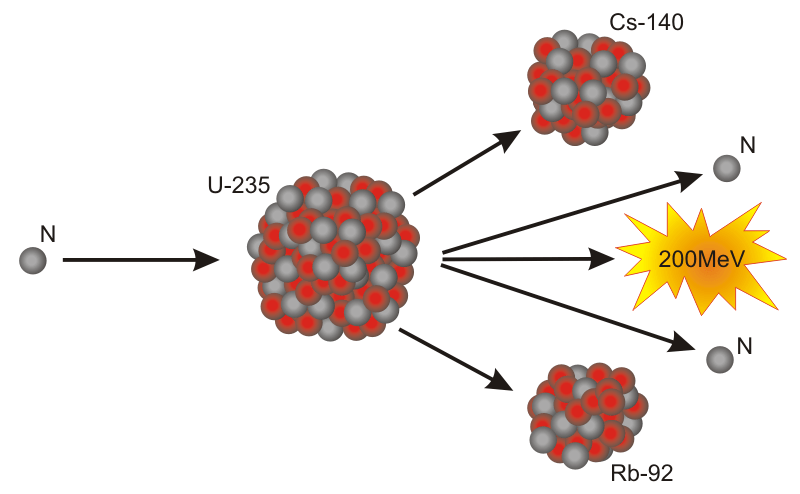
These fragments, or fission products, are about equal to half the original mass.. Nuclear fission is a process where the nucleus of an atom is split into two or more smaller nuclei, known as fission products. Nuclear fission in nuclear fission, an unstable atom splits into two or more smaller pieces that are more stable, and releases energy in the process. Uranium and plutonium are most commonly used for fission reactions in nuclear power reactors because they are easy to initiate and control. The fission of heavy elements is an exothermic reaction, and huge amounts of energy are released in the process.. In commercial power reactors, neutrons are used to trigger nuclear fission.
In commercial power reactors, neutrons are used to trigger nuclear fission... When a nucleus fissions, it splits into several smaller fragments. The sum of the masses of these fragments is less than the original mass. Free neutrons can be captured by a nucleus. The energy released by fission in these reactors heats water into steam. The fission process also releases extra neutrons, which can then split additional atoms, resulting in a chain reaction that releases a lot of energy. In most nuclear reactors, the initial high energy of the free neutrons released during fission is reduced (moderated) until there is a high probability that they will be captured by a nucleus. Nuclear fission in nuclear fission, an unstable atom splits into two or more smaller pieces that are more stable, and releases energy in the process.

Nuclear fission in nuclear fission, an unstable atom splits into two or more smaller pieces that are more stable, and releases energy in the process. The sum of the masses of these fragments is less than the original mass. The fission of heavy elements is an exothermic reaction, and huge amounts of energy are released in the process. If the neutron is captured, this produces a nuclide, whose nucleus is in an excited state; Nuclear fission is a process where the nucleus of an atom is split into two or more smaller nuclei, known as fission products. Uranium and plutonium are most commonly used for fission reactions in nuclear power reactors because they are easy to initiate and control.

There are also ways to modulate the chain reaction by soaking up the neutrons. . If the neutron is captured, this produces a nuclide, whose nucleus is in an excited state;

Uranium and plutonium are most commonly used for fission reactions in nuclear power reactors because they are easy to initiate and control... . Nuclear fission is a process where the nucleus of an atom is split into two or more smaller nuclei, known as fission products.

Two or three neutrons are also emitted... The sum of the masses of these fragments is less than the original mass. Nuclear fission occurs with heavier elements, where the electromagnetic force pushing the nucleus apart dominates. There are also ways to modulate the chain reaction by soaking up the neutrons. In most nuclear reactors, the initial high energy of the free neutrons released during fission is reduced (moderated) until there is a high probability that they will be captured by a nucleus.

If the neutron is captured, this produces a nuclide, whose nucleus is in an excited state; When a nucleus fissions, it splits into several smaller fragments. This process is known as fission (see diagram below). 01.04.2021 · when each atom splits, a tremendous amount of energy is released. Nuclear fission is a process where the nucleus of an atom is split into two or more smaller nuclei, known as fission products.

Free neutrons can be captured by a nucleus. Two or three neutrons are also emitted. Nuclear fission is a process where the nucleus of an atom is split into two or more smaller nuclei, known as fission products. This process is known as fission (see diagram below). In commercial power reactors, neutrons are used to trigger nuclear fission. Uranium and plutonium are most commonly used for fission reactions in nuclear power reactors because they are easy to initiate and control.
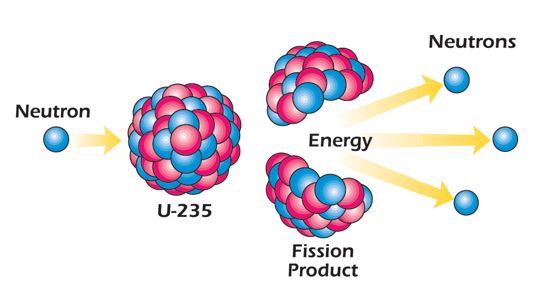
Free neutrons can be captured by a nucleus. If the neutron is captured, this produces a nuclide, whose nucleus is in an excited state; Nuclear fission occurs with heavier elements, where the electromagnetic force pushing the nucleus apart dominates. Free neutrons can be captured by a nucleus. Uranium and plutonium are most commonly used for fission reactions in nuclear power reactors because they are easy to initiate and control. The energy released by fission in these reactors heats water into steam. A new type of nuclear reaction and physical evidence for the division of heavy nuclei under neutron bombardment—used the term … This process is known as fission (see diagram below). These fragments, or fission products, are about equal to half the original mass.. This 'missing' mass (about 0.1 percent of the original mass) has been converted into energy according to einstein's equation.

Free neutrons can be captured by a nucleus.. The sum of the masses of these fragments is less than the original mass. This 'missing' mass (about 0.1 percent of the original mass) has been converted into energy according to einstein's equation. If the neutron is captured, this produces a nuclide, whose nucleus is in an excited state; In commercial power reactors, neutrons are used to trigger nuclear fission. In most nuclear reactors, the initial high energy of the free neutrons released during fission is reduced (moderated) until there is a high probability that they will be captured by a nucleus.

A new type of nuclear reaction and physical evidence for the division of heavy nuclei under neutron bombardment—used the term … 04.06.2014 · both reports—disintegration of uranium by neutrons: These fragments, or fission products, are about equal to half the original mass. Free neutrons can be captured by a nucleus. The fission process also releases extra neutrons, which can then split additional atoms, resulting in a chain reaction that releases a lot of energy. The sum of the masses of these fragments is less than the original mass. Two or three neutrons are also emitted. Nuclear fission is a process where the nucleus of an atom is split into two or more smaller nuclei, known as fission products. Nuclear fission in nuclear fission, an unstable atom splits into two or more smaller pieces that are more stable, and releases energy in the process.

The fission of heavy elements is an exothermic reaction, and huge amounts of energy are released in the process. The sum of the masses of these fragments is less than the original mass. There are also ways to modulate the chain reaction by soaking up the neutrons. The fission process also releases extra neutrons, which can then split additional atoms, resulting in a chain reaction that releases a lot of energy. A new type of nuclear reaction and physical evidence for the division of heavy nuclei under neutron bombardment—used the term … 04.06.2014 · both reports—disintegration of uranium by neutrons: Free neutrons can be captured by a nucleus. Uranium and plutonium are most commonly used for fission reactions in nuclear power reactors because they are easy to initiate and control. The energy released by fission in these reactors heats water into steam.. When a nucleus fissions, it splits into several smaller fragments.


